
What is the CEnT-S exam? A complete guide for international students
Here are the newly announced updates on the CEnT-S test, which will replace the TOLC test previously administered by Politecnico di Milano.
The preparation course for the CEnT-S and TIL-I tests is launched! Click here to see to course calendar and here for the course details.
CEnT-S
The CEnT-S is the CISIA English test required by some universities to pursue degree courses mainly held in English in Engineering, Economics, Pharmacy, and other scientific fields.
Before booking a CEnT-S, check the admission notice of your university degree course on the university’s website: there you can find the information about the admission procedures and deadlines.
CEnT-S structure
The test consists of 55 questions, divided into 5 sections:
- Mathematics
- Reasoning on texts and data
- Biology
- Chemistry
- Physics.
You can find CEnT-S syllabus in more detail here.
CEnT-S
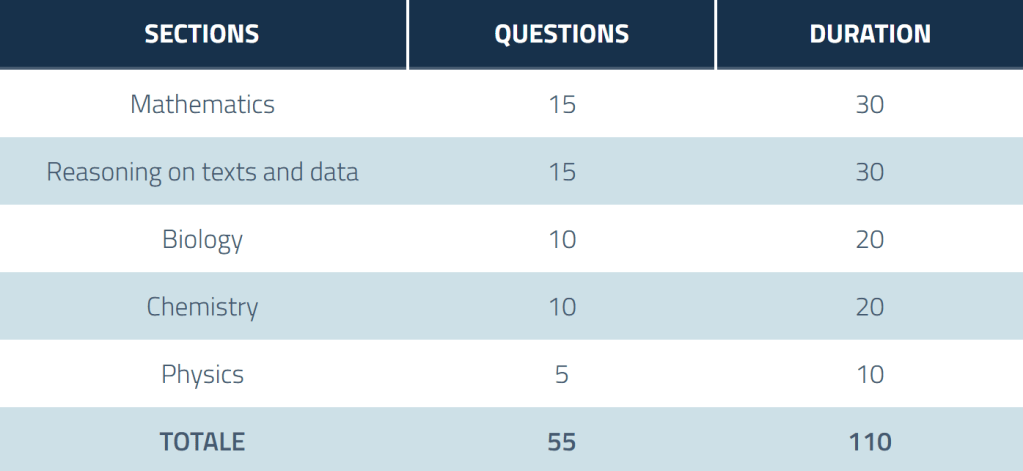
Each section must be completed within a set time limit: once the time is up, you must proceed to the next section. If you complete the section before the time runs out, you can move on to the next one. Please consider that in this case you will not be able to use the remaining time to complete other sections of the test and that you will not be able to go back to the previous section.
Evaluation of the test and normalisation
The CEnT-S result is based on the number of correct, unanswered, incorrect responses, that sum up to a raw score:
- 1 point for each correct answer
- 0 points for each unanswered question
- a penalty of 0.25 points for each incorrect answer.
The normalised score (the final official test result) is calculated from the raw score, which is based on the answers given to each question (as indicated on the test Syllabus page). A normalisation coefficient is then added to this number, which is larger the more difficult the test taken turns out to be: a more difficult test is compensated by a higher normalisation coefficient. The coefficient is calculated at the end of the macro-period by analysing the results of the questions (whose difficulty is not known in advance) and thus determining the actual level of difficulty of each test.
The normalised score will be available in the CISIA Student Area only at the end of the macro-period in which the test has been taken:
- by January 30th for the first macro-period
- by March 31st for the second macro-period
- by June 30th for the third macro-period
- by October 30th for the fourth macro-period.
Want to pass the CEnT-S exam and get into Engineering in Italy?
Join polimitestprep’s CEnT-S course and study with structured lessons, real exam-style questions!
Considering studying by yourself? Here’s our guide for a clear 8–12 week plan tailored for international students.
CEnT-S – a Complete overview
The preparation course for the CEnT-S test is launched!
CEnT: the English Test
The CEnT (CISIA English Test) is the admission test for admission to degree courses that are mainly held in English.
Starting in November 2025, the previous English TOLC types (English TOLC-E, English TOLC-I and English TOLC-F) will be replaced by a new unified test: the CEnT -S (CISIA English Test-Sciences) valid for admission to degree courses in Engineering, Economics, Pharmacy, and other scientific fields.
Before booking the test, check the admission notice or call for admission for the degree program you’re interested in on the university website. You will find detailed information about access procedures and deadlines to be met.
The CEnT at a glance
CEnT@UNI or CEnT@HOME
The CEnT can be held in two different formats:
- CEnT@HOME: remotely
- CEnT@UNI: in university classrooms.
Read more on the CEnT@UNI and CEnT@HOME page.
When to take the CEnT
You can take the test only once per macro-period:
- November, December, January (first macro-period)
- February, March (second macro-period)
- April, May, June (third macro-period)
- September, October (fourth macro-period).
To find out about the format accepted and the validity of your CEnT, check the admission notice on the university website.
Check the list of CEnT dates you can book on the Available dates calendar. It’s the universities that directly schedule the dates.
The universities directly schedule the dates: make sure to check back often.
Repeating the CEnT
You can take the CEnT once every macro-period.
Starting the day after your CEnT, you will be able to book another one for the following macro-periods.
Fee and payment methods
Every CEnT costs 55 Euros and you can pay this fee by:
- credit card
- bank payment slip – MAV (only through Italian payment systems).
Read how to book a CEnT to know the steps you must take.
After the CEnT
At the end of the test, the number of correct, unanswered, and incorrect responses will be provided; the same information can be downloaded in PDF format from the CISIA Student Area.
However, the final normalised score will be available in your CISIA Student Area only at the end of the macro-period in which you took your test:
- by January 30th for the first macro-period
- by March 31st for the second macro-period
- by June 30th for the third macro-period
- by October 30th for the fourth macro-period.
Follow the instructions in the admission notice to enrol.

How to Book your CEnT-S exam?
1. Read the or call for admission of your university degree course
When reading the admission notice, pay attention to:
- the deadline you must meet to take the CEnT
- the format accepted: CEnT@UNI or CEnT@HOME
- the enrolment procedures you need to follow.
You can find the admission notice on the university’s website.
2. Sign up to the CISIA Student Area
- Read on the Guide how to complete your registration
- Fill in the CISIA Student Area registration form to create an account
After signing up, you must check your email and click the activation link to confirm your account.
If you have a disability or specific learning difficulties, please indicate this at the end of the registration form.
3. Check the CEnT dates
You find the list of CEnT dates you can book on the Available Dates calendar.
Choose a date that meets the deadlines set by the admission notice of your degree course.
For each date you can see the booking state (available seats, not longer available, closed bookings) and the booking deadline.
Please note that you can choose a CEnT date held by any university, even if the university is different from the one you want to apply to: the result will be valid for any degree course that accepts the CEnT in that format for admission.
Check the Guide for more information about the calendar.
4. Book a CEnT
- Log in to your CISIA Student Area
Please browse the English version of the website. Do not use an automatic translator.
- Scroll down the homepage and click on CEnT-S
- Choose the format as stated on the admission notice
- Read the Rules for CEnT participants, the Terms and Conditions of use of the Service and other informational documents
- Choose a payment method
- Using the region, city, universitydrop-down menus, select the date you have chosen when reading the Available dates calendar
- Select which is your student status
- Click on the Continue button
- Read the booking summary and, if the booking details are correct, click on the Confirm button
- Follow the instructions to complete the payment
After completing the procedure, check that your CEnT booking has been successfully completed in the Manage Bookings section of your CISIA Student Area.
5. Check your test entry time
You can find your test entry time only on your Payment and Enrolment Receipt.
You will be able to download the Payment and Enrolment Receipt after:
- the payment status is Completed
- your profile picture has been uploaded.
If you have booked a CEnT@HOME, you must also:
download and install the Horizon APP from your CISIA Student Area by the day before your CEnT.

TIL-I test in English: structure, scoring and strategy for Politecnico di Torino
If you want to study Engineering at Politecnico di Torino (PoliTo), you will almost certainly meet one key acronym: TIL-I.
The TIL-I test (Test In Laib – Ingegneria) is the official admission test for engineering bachelor’s degrees at Politecnico di Torino. It is:
- mandatory for almost all engineering programmes,
- available in English and Italian,
- and used directly to rank candidates and assign places. Polito
This guide explains the TIL-I test in English from an international-student point of view:
- what the TIL-I test is,
- how the TIL-I structure works (sections, timing, contents),
- how TIL-I scoring and thresholds work,
- how many times you can take the TIL-I test,
- and a section-by-section strategy to maximise your TIL-I score.
1. What is the TIL-I test?
The TIL-I test is the entrance exam for engineering bachelor’s degrees at Politecnico di Torino. TIL stands for “Test In Laib” (LAIB are PoliTo’s computer labs).
According to the official Call for Applications for Engineering at Politecnico di Torino, the TIL-I test:
- is a computer-based test taken in the university’s labs,
- is an individual test, different for each candidate but with equivalent difficulty,
- is available in English and in Italian,
- is required for admission to engineering bachelor’s programmes (unless you belong to very specific exemption categories listed in the Call).
For students with a non-Italian qualification, passing the TIL-I test is usually the main route into PoliTo engineering (SAT can sometimes exempt you, but not for all programmes, and not for Architecture).
2. TIL-I structure: sections, questions and timing
The official English call for Engineering 2025/26 describes the TIL-I structure very clearly:
- Total TIL-I questions: 42
- Total TIL-I time: 90 minutes (1 hour 30 minutes)
- Question format: multiple choice, 5 options (A–E), only one correct
The TIL-I test is divided into 4 sections:
- Mathematics – 16 questions – 36 minutes
- Reading Comprehension and Logical Reasoning – 10 questions – 20 minutes
- Physics – 10 questions – 22 minutes
- Basic Technical Knowledge – 6 questions – 12 minutes
Once the time for a section is over, you cannot go back to it. Each candidate receives a TIL-I test where the questions are randomly selected by a computer system but with the same overall difficulty.
2.1 TIL-I Mathematics section
- 16 questions – 36 minutes
- Focus on high-school mathematics relevant to engineering:
- algebra (equations, inequalities, systems),
- functions and graphs,
- geometry and trigonometry,
- sequences, combinatorics/probability (depending on syllabus).
Because Mathematics is the largest section, it also carries the most weight in tie-breaking and rankings.
2.2 TIL-I Reading Comprehension & Logical Reasoning section
- 10 questions – 20 minutes
- Tests your ability to:
- understand short texts (often technical or semi-technical),
- interpret statements and arguments,
- apply logic and deduction.
Even if maths and physics are strong, poor performance here can drag down your overall TIL-I score.
2.3 TIL-I Physics section
- 10 questions – 22 minutes
- Topics typically include:
- kinematics (velocity, acceleration),
- Newton’s laws and forces,
- work, energy, power,
- simple circuits (voltage, current, resistance).
Calculus is not required: the focus is on conceptual understanding and basic formula application rather than long calculations.
2.4 TIL-I Basic Technical Knowledge section
- 6 questions – 12 minutes
- Covers technical drawing, basic engineering concepts and informatics (depending on the year’s syllabus).
Although it’s the smallest section, it can give you extra points that make the difference in highly competitive courses.
3. TIL-I scoring and admission thresholds
3.1 How the TIL-I is scored
The TIL-I scoring system is straightforward and is explicitly defined in Art. 7 of the Call for Engineering:
- +1 point for each correct answer
- 0 points for each unanswered question
- –0.25 points for each wrong answer
Your raw TIL-I score is then converted into a value on a 0–100 scale (effectively a percentage), which is used for rankings and thresholds.
3.2 TIL-I thresholds: minimum and “guarantee” score
Specialist test-prep sites that quote PoliTo’s regulations summarise the thresholds like this: Unitest
- Minimum threshold (soglia minima): 30/100
- You need at least 30/100 to be included in the ranking lists for engineering.
- Guarantee threshold (soglia di garanzia): 60/100
- With 60/100 or higher, you generally have a “guarantee score” that allows you to enrol in your first-choice degree (subject to details in the Call and available spots).
Candidates with scores between 30/100 and 60/100 are admitted based on: Unitest
- the number of places available in each course,
- their position in the ranking for that course,
- tie-breaking rules that prioritise higher scores in Mathematics, then Reading & Logic, then Physics, then Technical Knowledge, and finally the younger candidate in case of perfect ties.
3.3 How many times can you take the TIL-I?
The Call explicitly states that: Polito
- you can take the TIL test (TIL-I included) at most 3 times in total,
- but only once per session.
PoliTo organises several TIL-I sessions across the year (spring and summer), and the best TIL-I score you obtain is normally used for admission.
4. TIL-I in English vs Italian: what changes?
The Engineering Call clarifies that the TIL-I test is available in both English and Italian.
For international students applying to English-taught engineering programmes, the typical scenario is:
- you choose the English version of the TIL-I,
- the structure, number of questions and scoring are exactly the same as the Italian version,
- only the language of the statements and passages changes.
Taking the TIL-I test in English has two advantages if you plan to study in English:
- you prove that you can handle technical reasoning in English,
- you avoid the extra cognitive load of reading physics and logic questions in Italian.
However, note that language requirements (B2 English, possible Italian requirements) are separate from TIL-I—those are handled under language certificates and programme rules in the Call for Applications.
5. Registration, sessions and course choices
5.1 How to register for the TIL-I test
The official Admission Test (TIL) page explains that you need to: Polito+1
- Create an account on Apply@polito (PoliTo’s application platform).
- Select the TIL-I test session you want from the calendar.
- Pay the TIL test fee and complete the registration before the specified deadline.
The detailed procedures, deadlines and fees are always listed in the Call for Applications for the Engineering area for the relevant academic year. Polito+1
5.2 Choosing up to 5 engineering programmes
When you register for the TIL-I test, you can indicate up to 5 engineering bachelor’s degrees you would like to study, in order of preference. Polito
- Each engineering course has a limited number of seats.
- After the TIL-I sessions, PoliTo creates a ranking list for each programme, where applicants are ordered by their TIL-I scores and preferences.
- Your TIL-I score and your order of preferences determine which course you are admitted to.
Because of this, strategy in choosing and ordering your 5 preferences is almost as important as your raw TIL-I score.
6. Strategy for each section of the TIL-I test
Now that we’ve covered TIL-I structure and TIL-I scoring, let’s look at how to prepare strategically, especially if you’re taking the TIL-I test in English.
6.1 TIL-I Mathematics: your main weapon
Mathematics has:
- the largest number of questions,
- strong impact in tie-breaking,
- and is closest to first-year engineering courses.
Goals:
- Aim to be solid on all standard high-school maths topics:
- algebra, equations, inequalities,
- functions, graphs and domains,
- geometry (areas, volumes, trigonometry basics),
- word problems, proportionality and percentage.
- Practise on TIL-I style questions with a timer:
- 16 questions in 36 minutes is just over 2 minutes per question.
Strategy tips:
- Start each question by spotting what’s being asked: “equation solving? geometry? function behaviour?”
- Use rough estimates to quickly eliminate obviously wrong options.
- If a question seems very long or unusual, mark it and move on, coming back only if time allows. One very hard problem can burn the time needed to answer three easier ones.
6.2 Reading Comprehension & Logical Reasoning: don’t neglect it
For international students taking TIL-I in English, this section is often the most surprising.
Goals:
- Read short English passages efficiently: identify main idea, key details, and logical connections.
- Recognise common patterns: cause–effect, comparison, conditional statements, contradictions.
Strategy tips:
- In practice, always:
- read the question first, then the passage (so you know what to look for),
- underline or mentally note numbers, keywords and negatives (“not”, “except”).
- If you don’t know a word, don’t freeze—use context. The question rarely hinges on understanding a single obscure term.
- For logic puzzles, draw a quick mini diagram or table instead of juggling all the information in your head.
Because there is no separate penalty for reading slowly, the main danger here is rushing and misreading, which leads straight to –0.25 penalties.
6.3 Physics: connect formulas to intuition
Physics questions usually test conceptual understanding plus basic algebra, not heavy calculus.
Goals:
- Memorise the core formulas for:
- constant and uniformly accelerated motion,
- forces and Newton’s laws,
- work, potential and kinetic energy, power,
- Ohm’s law and simple series/parallel circuits.
- Practise converting words into equations: “constant speed”, “uniform acceleration”, “power consumed”, etc.
Strategy tips:
- Before plugging into formulas, ask yourself:
“Should the result be bigger or smaller than X? Positive or negative?”
This helps you catch sign or magnitude mistakes. - Keep units consistent (m, s, kg, N, J, W…). If the units in your answer don’t match, something is wrong.
- If a problem looks very messy, check whether you’re overcomplicating it; many TIL-I physics questions only require one or two simple steps.
6.4 Basic Technical Knowledge: easy points if you prepare
Even though it’s only 6 questions, this section can give you “bonus” points that push you above a threshold or above another candidate.
Goals:
- Learn the basic vocabulary of technical drawing and engineering (e.g. orthogonal projections, scale, simple mechanical elements).
- Review simple informatics concepts if they are listed in the year’s TIL-I topics (binary vs decimal, hardware vs software, basic logic gates).
Strategy tips:
- Because the section is short and time is tight, avoid getting stuck. If you have no idea, it may be better to leave a question blank than to give a random answer and risk –0.25.
- Use common sense: some questions can be answered by reasoning about how things work in real life (e.g. what happens if you increase the resolution of a drawing, or how a simple machine behaves).
7. Global TIL-I strategy: before, during and after the test
7.1 Before the TIL-I test
- Check the latest Call for your year and for the Engineering area:
- structure and scoring (in case of updates),
- test dates and sessions,
- registration deadlines and conditions,
- any exemptions or special rules for non-Italian qualifications. Polito+1
- Decide whether you will sit the TIL-I in English or Italian (for an English-taught degree, the English TIL-I is usually more natural).
- Plan at least 8–12 weeks of preparation, with progressively more timed practice and full mock exams as the test day approaches.
7.2 On TIL-I test day
- Arrive early at the LAIB computer lab; technical checks and seat assignment can take a bit of time.
- Bring all required documents (ID, any special needs documents if applicable).
- In each section:
- skim all questions quickly,
- start with the ones that look easiest or most familiar,
- keep one eye on the section timer—it moves faster than you expect.
For the negative marking:
- Do not blindly click answers just to avoid blanks;
- Guess only when you can eliminate several options;
- Leave truly impossible questions blank to avoid “free” –0.25 hits.
7.3 After the TIL-I test: retakes and strategy
Since you can attempt the TIL-I up to three times (once per session), it’s smart to: Ammissione
- book an early session in the year, so you have room to retake if needed,
- after each attempt, analyse which section was weakest and adapt your preparation,
- keep track of how your TIL-I score evolves across attempts.
If you reach or exceed the 60/100 guarantee threshold, you may be eligible for early enrolment in your first-choice course (check the specific instructions and dates in your year’s Call). Unitest
8. Key takeaways: TIL-I test in English for PoliTo
- The TIL-I test is the official entrance exam for engineering bachelor’s degrees at Politecnico di Torino. Polito
- The TIL-I structure: 42 questions, 4 sections (Maths, Reading & Logic, Physics, Basic Technical Knowledge), 90 minutes total.
- The TIL-I scoring system: +1 for correct, 0 for blank, –0.25 for wrong answers; thresholds are 30/100 (minimum for ranking) and around 60/100 (guarantee threshold for first preference, subject to the Call). Unitest
- The TIL-I test is available in English and Italian, and the English version is especially relevant for international students aiming at English-taught engineering programmes.
- You can take the TIL-I up to three times, once per session; PoliTo considers your best score for admission.
With a clear understanding of the TIL-I test in English, its structure and scoring, and a solid preparation plan focused on Mathematics, Logic, Physics and Technical Knowledge, you can turn the TIL-I from a mysterious hurdle into a structured challenge you know how to approach.
9. How can I best prepare for the CEnT-S and/or TIL-I?
With polimitestprep! After successfully helping 75 students to enrol into the architecture programs of both Polimi and Polito, we are starting courses on engineering tests! If you would like to prepare for CEnT-S and/or TIL-I with polimitestprep, sign up here!
Check the CEnT-S & TIL-I course calendar here.
Want to pass the TIL-I test and get into Polito?
Join polimitestprep’s TIL-I course and study with exper instructors!
Want to know more about the TIL-I test? Here’s our comprehensive guide on the TIL-I test .

Everything you need to know about the CEnT-S and TIL-I tests for starting your Bachelor’s in Science in Engineering at the Politecnico di Milano and Politecnico di Torino:
The complete guide for Politecnico di Milano and Politecnico di Torino
If you want to study Engineering in Italy in English, you will quickly meet three names over and over again:
- the CEnT-S test,
- the English TOLC-I,
- the TIL-I test.
All three are entrance tests for bachelor’s programmes in Engineering and other scientific fields, and they matter a lot for admission to universities such as Politecnico di Milano and Politecnico di Torino.
This guide explains, in detail and in English:
- what the CEnT-S test is,
- how the CEnT-S test replaces the English TOLC-I and other English TOLCs,
- what the English TOLC-I used to look like,
- how the TIL-I test works at Politecnico di Torino,
- how international students should plan CEnT-S, English TOLC-I (if still accepted) and TIL-I when applying to Italian engineering programmes.
1. What is the CEnT-S test?
The CEnT-S test (CISIA English Test – Sciences) is the new unified English entry test created by CISIA. Starting in November 2025, CEnT-S becomes the single English test used by CISIA for scientific areas and it replaces the previous English TOLC-I, English TOLC-E and English TOLC-F. CISIA+2CISIA+2
According to CISIA, the CEnT-S test:
- is held entirely in English,
- is used for admission to degree programmes mainly taught in English in Engineering, Economics, Pharmacy and other scientific fields, CISIA+1
- is offered in both CEnT-S @UNI (in-person at university computer labs) and CEnT-S @HOME (online from home, with remote proctoring), just like the old English TOLC tests. CISIA+1
In short: the CEnT-S test is now the standard CISIA English test you need to know if you are aiming for an English-taught scientific bachelor’s degree at many Italian universities.
1.1 CEnT-S test structure
The official CISIA description of the CEnT-S test shows a very clear structure: CISIA+1
- Total questions: 55
- Total time: 110 minutes
- Sections of the CEnT-S test:
- Mathematics – 15 questions – 30 minutes
- Reasoning on texts and data – 15 questions – 30 minutes
- Biology – 10 questions – 20 minutes
- Chemistry – 10 questions – 20 minutes
- Physics – 5 questions – 10 minutes
Each section of the CEnT-S test has its own fixed time limit. Once the time for a section is over, you must move on; you cannot go back to previous sections.
1.2 CEnT-S scoring and macro-periods
The CEnT-S test uses the same scoring logic that CISIA already applied to the English TOLC-I:
- +1 point for each correct answer,
- 0 points for each unanswered question,
- –0.25 points for each incorrect answer. CISIA+1
At the end of the test, you see your raw CEnT-S score. Then, at the end of each macro-period, CISIA normalises the scores statistically, so that different CEnT-S sessions across different days become comparable. The normalised CEnT-S score is the one that universities actually use for rankings and admission. CISIA+1
CISIA runs the CEnT-S test in four macro-periods during the academic year (for example November–January, February–March, April–June, September–October), and you can normally take one CEnT-S per macro-period. CISIA+2apply.unive.it+2
For international students planning applications to Politecnico di Milano or Politecnico di Torino, this means:
- you have several opportunities to sit the CEnT-S test during the year,
- you must check each university’s call for applications to see which CEnT-S macro-periods are accepted for that intake.
2. How the CEnT-S test replaces the English TOLC-I
Before the CEnT-S test existed, the main CISIA English exam for Engineering was the English TOLC-I.
The English TOLC-I:
- was one of the English TOLC tests offered by CISIA (English TOLC-E, English TOLC-I, English TOLC-F),
- was used as an admission or evaluation test for engineering bachelor’s programmes taught in English,
- had a fixed structure of 50 questions in 110 minutes, divided into:
- Mathematics – 20 questions – 50 minutes
- Logic – 10 questions – 20 minutes
- Sciences – 10 questions – 20 minutes
- Reading comprehension – 10 questions – 20 minutes. CISIA+1
Just like the CEnT-S test, the English TOLC-I used the scoring rule +1 / –0.25 / 0 for correct / wrong / blank answers, and it was offered in @UNI and @HOME formats via CISIA. CISIA+2CISIA+2
2.1 From English TOLC-I to CEnT-S: what changed?
CISIA now states clearly that, starting in November 2025, the CEnT-S test replaces all the previous English TOLC variants: English TOLC-I, English TOLC-E and English TOLC-F. CISIA+2CISIA+2
For you as a student, that means:
- If you find older information saying “you must take the English TOLC-I”, in many cases this requirement is now updated to “you must take the CEnT-S test”.
- The CEnT-S test is the new unified English exam for admission to science-based bachelor’s degrees, including engineering.
However, universities are free to decide how they use the CEnT-S result. Some may:
- require the CEnT-S test instead of English TOLC-I,
- accept past English TOLC-I results for a transitional period,
- or keep other admission schemes (for example, Politecnico di Milano’s own TOL for Italian-taught engineering).
This is why you must always check the latest admission notice on the website of Politecnico di Milano, Politecnico di Torino, or any other university you are applying to. Politecnico di Milano+2Politecnico di Milano+2
3. What is the TIL-I test at Politecnico di Torino?
The TIL-I test is not a CISIA TOLC and it is not replaced by the CEnT-S test.
The TIL-I test (Test in Laib – Ingegneria) is the official entrance exam designed by Politecnico di Torino for its bachelor’s programmes in Engineering. Polito+1
3.1 TIL-I test structure
Recent guides and PoliTo-related documents describe the TIL-I test like this: Supermat+2Supermat+2
- Total questions: 42
- Total time: 90 minutes (1 hour and 30 minutes)
- Sections of the TIL-I test:
- Mathematics – 16 questions – 36 minutes
- Text comprehension and Logic – 10 questions – 20 minutes
- Physics – 10 questions – about 20–22 minutes
- Basic Technical Knowledge (technical drawing and informatics) – 6 questions – 12 minutes
The TIL-I test is a computer-based test held in presence, usually in PoliTo’s computer labs (LAIB) or in other authorised locations in Italy. Polito+2Unitest+2
Like CISIA tests, the TIL-I test uses multiple-choice questions with five options and a scoring system with:
- +1 point for each correct answer,
- –0.25 points for each wrong answer,
- 0 points for unanswered questions. Ammissione+1
The maximum number of attempts is typically three TIL-I sessions per year, and the best TIL-I score is the one that counts for admission to engineering at Politecnico di Torino. Polito+1
3.2 TIL-I test and Politecnico di Torino admission
To enter engineering bachelor’s degrees at Politecnico di Torino, passing the TIL-I test is obligatory; it is the core element in the ranking that determines whether you will get a place in your preferred engineering programme. Polito+1
So for Politecnico di Torino:
- the TIL-I test is the primary admission test for engineering,
- the CEnT-S test can still be useful for other universities in Italy, but it does not replace the TIL-I test for PoliTo engineering,
- you may end up taking both the CEnT-S test (for other universities or extra options) and the TIL-I test (specifically for PoliTo).
4. CEnT-S test vs English TOLC-I vs TIL-I test – side-by-side
To make the differences between the CEnT-S test, the English TOLC-I, and the TIL-I test clearer, here is a conceptual comparison you can reflect in your own table on the website.
4.1 Who creates and uses each test?
- CEnT-S test
- Created and managed by CISIA. CISIA+1
- Used by multiple Italian universities for English-taught bachelor’s degrees in Engineering, Economics, Pharmacy, etc. CISIA+2University of Milano-Bicocca+2
- English TOLC-I
- Also created and managed by CISIA as an English version of TOLC-I, focused on Engineering. CISIA+1
- Used in the past by several universities; now replaced by CEnT-S for scientific English-taught programmes. CISIA+2CISIA+2
- TIL-I test
- Created and managed by Politecnico di Torino itself (a university-specific test, not a TOLC). Polito+1
- Used exclusively for admission to engineering bachelor’s programmes at Politecnico di Torino.
4.2 Format and structure
- CEnT-S test
- 55 questions, 5 sections (Mathematics, Reasoning on texts and data, Biology, Chemistry, Physics).
- 110 minutes total. CISIA+1
- English TOLC-I
- 50 questions, 4 sections (Mathematics, Logic, Sciences, Reading comprehension).
- 110 minutes total. CISIA+1
- TIL-I test
- 42 questions, 4 sections (Mathematics, Text comprehension & Logic, Physics, Basic Technical Knowledge).
- 90 minutes total. Supermat+2Supermat+2
All three (CEnT-S test, English TOLC-I, TIL-I test) share the +1 / –0.25 / 0 scoring system for correct / wrong / blank answers, which creates similar strategic constraints: you cannot just guess everything, you must think about whether each guess is worth the risk. CISIA+2CISIA+2
4.3 When and where can you take them?
- CEnT-S test
- Offered in four macro-periods throughout the year.
- You can usually take the CEnT-S test once per macro-period.
- Available as CEnT-S @UNI (on campus) and CEnT-S @HOME (at home). CISIA+2apply.unive.it+2
- English TOLC-I
- Historically offered many times per year in @UNI and @HOME modes; availability is now being phased out as CEnT-S replaces the English TOLC-I. CISIA+2CISIA+2
- TIL-I test
5. How does this affect applications to Politecnico di Milano and Politecnico di Torino?
5.1 Politecnico di Milano and the CEnT-S test
Politecnico di Milano uses different admission tools for its bachelor’s programmes (“Laurea Programmes”):
- TOL (its own test) and sometimes TOLC-I for Italian-taught engineering; Politecnico di Milano+2CISIA+2
- historically English TOLC-I for some English-taught engineering degrees, now gradually transitioning to the CEnT-S test as the new CISIA standard for English-taught scientific programmes. CISIA+2CISIA+2
Because official rules can change each academic year, you must check:
- the Politecnico di Milano “Admission to Laurea Programmes” page, and
- the specific call for applications for your programme (for example Industrial Engineering or Engineering Science)
to see whether CEnT-S, TOLC-I or the internal TOL is required for your specific intake. Politecnico di Milano+2Politecnico di Milano+2
5.2 Politecnico di Torino and the TIL-I test
For Politecnico di Torino, the situation is clearer:
- the TIL-I test is the main entrance test for engineering bachelor’s degrees, and
- all candidates (Italian and international) who want to study engineering at PoliTo in Turin must sit and pass the TIL-I test, regardless of whether they have already taken the CEnT-S test. Polito+2WeTest+2
You can normally:
- attempt the TIL-I test up to three times,
- only once in each TIL-I session,
- and only in presence (there is no TIL-I @HOME version). Polito+2WeTest+2
For many international students, the optimal strategy is:
- take the CEnT-S test to keep options open at multiple Italian universities that use CEnT-S for English-taught engineering,
- and separately register for the TIL-I test if Politecnico di Torino is one of your top choices.
6. Practical planning for international students
If you are planning to apply to Politecnico di Milano and Politecnico di Torino in the coming years, you will likely deal with:
- the CEnT-S test (as the successor of the English TOLC-I),
- the TIL-I test (specific to Politecnico di Torino),
- possibly the TOL or TOLC-I if you also consider Italian-taught programmes.
A realistic plan could look like this:
- Choose your target programmes
- English-taught engineering at Politecnico di Milano → check if they require CEnT-S, TOL/TOLC-I or both.
- Engineering at Politecnico di Torino → plan to sit the TIL-I test.
- Book your CEnT-S macro-periods early
- Pick an early CEnT-S test date (first or second macro-period) so you have time to repeat the CEnT-S test if needed. apply.unive.it+1
- Align TIL-I test dates with CEnT-S
- Check the TIL-I calendar on PoliTo or partner sites: you normally have several sessions between March and late summer. Unitest+1
- Avoid booking a CEnT-S test and a TIL-I test too close together if you want time to review between them.
- Prepare with the specific test format in mind
- For the CEnT-S test: focus on Mathematics, Reasoning on texts and data, Biology, Chemistry and Physics in English; practice with CEnT-S-style simulations and timing (55 questions / 110 minutes). CISIA+2European Study Hub+2
- For the TIL-I test: specialise in Mathematics, Logic & reading, Physics and Technical Knowledge, with strict section time limits (42 questions / 90 minutes). Supermat+2Supermat+2
- Always confirm the latest rules
- Before you book any CEnT-S or TIL-I session, re-read the most recent call for applications for your degree at Politecnico di Milano and Politecnico di Torino. Admission rules, required tests and deadlines can change slightly from year to year. Politecnico di Milano+2Politecnico di Milano+2
7. Key takeaways: CEnT-S test, English TOLC-I and TIL-I test
If you want to study engineering at Politecnico di Milano and Politecnico di Torino, you should plan to sit both the CEnT-S test (as the successor of the English TOLC-I) and the TIL-I test, alongside any internal tests like TOL/TOLC-I that Politecnico di Milano may still require.
The CEnT-S test is the new unified CISIA English test for scientific fields; it replaces the English TOLC-I (and English TOLC-E/F) from November 2025 onward. CISIA+2CISIA+2
The English TOLC-I is now mainly relevant as a legacy test from previous years; new applicants should think in terms of the CEnT-S test instead of English TOLC-I. CISIA+2CISIA+2
The TIL-I test is the admission test created by Politecnico di Torino, required for engineering bachelor’s programmes at PoliTo and not replaced by CEnT-S. Polito+2WeTest+2
8. How can I prepare for the CEnT-S and/or TIL-I?
With polimitestprep! After successfully helping 75 students to enrol into the architecture programs of both Polimi and Polito, we are starting courses on engineering tests! If you would like to prepare for CEnT-S and/or TIL-I with polimitestprep, sign up here!
Not sure how to study for CEnT-S exam? Read our guide on“How to Prepare for the CEnT-S Test in 8–12 Weeks”.
CEnT-S vs English TOLC-I vs TIL-I: entrance to Politecnico di Milano and Politecnico di Torino
The CEnT-S test, the English TOLC-I and the TIL-I test are now the three key names you must know if you want to enter the bachelor’s programs in Engineering at Politecnico di Milano and Politecnico di Torino. The CEnT-S test (CISIA English Test – Sciences) is the new CISIA exam in English that replaces the English TOLC-I and all the other English TOLC versions (English TOLC-E and English TOLC-F) starting from November 2025. Cisia Online+1
The English TOLC-I used to be the standard CISIA online test in English for admission to engineering degrees, but from late 2025 onward, candidates aiming at English-taught bachelor’s programs in Engineering, Economics, Pharmacy and other scientific fields will sit the CEnT-S test instead of the English TOLC-I. Cisia Online+1
At the same time, the TIL-I test (Test in Laib – Ingegneria) remains the official entrance exam created by Politecnico di Torino for access to its bachelor’s programs in Engineering. The TIL-I test is a computer-based exam in presence, organized in several sessions each year, and it is still required to enter most engineering degrees at Politecnico di Torino. Polito+2Ammissione+2
What is the CEnT-S test (CISIA English Test – Sciences)?
The CEnT-S test is the new unified CISIA English test for scientific areas. According to CISIA, the CEnT-S test will replace English TOLC-I, English TOLC-E and English TOLC-F and will be required by universities for admission to bachelor’s programs mainly taught in English in Engineering, Economics, Pharmacy and other scientific fields. Cisia Online+2Cisia Online+2
The CEnT-S test:
- is held entirely in English
- is managed by CISIA, the same consortium that created the English TOLC-I
- can be taken in CEnT-S @CASA (from home, with remote proctoring) or CEnT-S @UNI (at a university test center), just like the old English TOLC tests Cisia Online+1
- is offered in macro-periods spread throughout the academic year; you can usually take the CEnT-S once per macro-period, on dates agreed between CISIA and participating universities apply.unipd.it+1
Structure of the CEnT-S test
The CEnT-S test has a very clear and standardized structure. CISIA specifies that the CEnT-S exam consists of 5 main sections: Cisia Online+1
- Mathematics
- Reasoning on texts and data
- Biology
- Chemistry
- Physics
In total the CEnT-S test includes 55 questions and the maximum time available is 110 minutes. This means you have about 2 minutes per question, so time management is crucial in the CEnT-S test, just as it was in the English TOLC-I. Cisia Online
The content is designed to test your general scientific preparation and your ability to reason in English, not just memorize formulas. Compared to the English TOLC-I, the CEnT-S test is more explicitly aimed at a broad range of scientific degrees and is fully standardized for all participating universities.
CEnT-S test and Politecnico di Milano
Politecnico di Milano is one of the first large technical universities to adopt the CEnT-S test for access to some of its English-taught engineering bachelor’s programs. On the CISIA page dedicated to Politecnico di Milano, you can already see that the CEnT-S test is required to access English-language, restricted-access courses such as Civil Engineering, Engineering Science, Industrial Engineering and Process Engineering. Cisia Online+1
In practice, for these English-taught degrees at Politecnico di Milano:
- where in the past you would have needed the English TOLC-I,
- now you will register for and sit the CEnT-S test;
- your CEnT-S result will be used in the admission rankings of Politecnico di Milano for those specific courses. Cisia Online+1
Politecnico di Milano also continues to use other admission tests, such as the TOL (its Italian-language online test for engineering) and the Arched test for architecture, so the CEnT-S test is part of a broader system of entrance exams used by the university. Politecnico di Milano+2Politecnico di Milano+2
English TOLC-I: what it was and why CEnT-S replaces it
The English TOLC-I was the CISIA online test in English for Engineering (the “I” stands for “Ingegneria/Engineering”). It was used by many Italian universities as an entrance exam for bachelor’s degrees in Engineering taught in English or as a way to assess students’ basic preparation.
The English TOLC-I:
- was delivered online in the same @CASA and @UNI modes as other TOLC tests;
- focused heavily on mathematics, logic, and basic science;
- had a fixed number of questions divided into quantitative and logical-reasoning areas;
- provided a score that universities could use directly or convert into ranks and thresholds. Cisia Online+1
With the new CEnT-S test, CISIA has decided to replace the English TOLC-I together with English TOLC-E and English TOLC-F. The idea is to create one single, unified English test for scientific degrees, making it easier for universities and students alike: one CISIA English test (CEnT-S) instead of several separate English TOLC types. Cisia Online+2Cisia Online+2
For you, this means that if you see old information online mentioning the English TOLC-I as a requirement for an English-taught engineering bachelor’s degree, you should check the latest admission call: in most cases the requirement will now have been converted to the CEnT-S test.
TIL-I test for Politecnico di Torino
The TIL-I test (Test in Laib – Ingegneria) is the official entrance test designed by Politecnico di Torino for access to its bachelor’s degrees in Engineering. Unlike the English TOLC-I, which is a CISIA test used by many universities, the TIL-I test is specific to Politecnico di Torino and is usually taken in the university’s computer labs (LAIB), in presence. Polito+2Polito+2
Structure of the TIL-I test
The TIL-I test assesses the skills needed for engineering studies at Politecnico di Torino, with a structure that typically includes: Ammissione+2Supermat+2
- Mathematics: 16 questions in about 36 minutes
- Logic and text comprehension: 10 questions in about 20 minutes
- Physics: 10 questions in about 20 minutes
- plus additional questions or sections depending on the year’s official call
The TIL-I test is multiple-choice, with scoring rules that reward correct answers and may penalize wrong answers (negative marking), so strategy and accuracy are extremely important. Candidates can usually sit the TIL-I test several times in different sessions, but only once per session; the official admission call (bando) specifies the exact limits and calendar for each academic year. Ammissione
For admission to engineering bachelor’s programs at Politecnico di Torino, the TIL-I test result is fundamental: your TIL-I score is used in the ranking that decides whether you get a place in your preferred engineering degree.
CEnT-S test, English TOLC-I and TIL-I test: how they relate to each other
To summarize the relationship between the CEnT-S test, the English TOLC-I and the TIL-I test for Politecnico di Milano and Politecnico di Torino:
- The English TOLC-I was formerly the CISIA English-language test for Engineering.
- From November 2025 onwards, the CEnT-S test replaces the English TOLC-I (and other English TOLC types) as the unified CISIA English test for scientific areas. Cisia Online+2Cisia Online+2
- Politecnico di Milano now requires the CEnT-S test for some English-taught, restricted-access engineering bachelor’s programs, making the CEnT-S test the reference CISIA exam instead of the English TOLC-I for those courses. Cisia Online+2testcisia.it+2
- The TIL-I test remains the specific entrance exam created by Politecnico di Torino for its engineering degrees; it is not replaced by CEnT-S but co-exists with it. If you want to study engineering at Politecnico di Torino, you must pass the TIL-I test, even if you also take the CEnT-S test for other universities. Polito+2Ammissione+2
In other words, the CEnT-S test and the TIL-I test are both crucial for future engineers in Italy:
- the CEnT-S test is the CISIA English test that has taken over from the English TOLC-I,
- the TIL-I test is the Politecnico di Torino exam that directly controls admission to its engineering bachelor’s programs.
Which test should you take?
If you are planning your studies for Politecnico di Milano and Politecnico di Torino, you will almost certainly come across all three names: CEnT-S test, English TOLC-I and TIL-I test.
- For Politecnico di Milano:
- for Italian-taught engineering degrees, you will typically take the TOL (PoliMi’s own test);
- for certain English-taught engineering bachelor’s programs, you will now take the CEnT-S test instead of the English TOLC-I. Politecnico di Milano+2Politecnico di Milano+2
- For Politecnico di Torino:
- the main required exam is the TIL-I test, which you must pass to enter engineering bachelor’s courses;
- the CEnT-S test can still be useful for other universities in Italy, but the TIL-I test is the central requirement for PoliTo engineering. Polito+1
Because the CEnT-S test, the English TOLC-I and the TIL-I test are all tightly connected to admission rules that can change from year to year, you should always read the latest official bando di ammissione on the websites of Politecnico di Milano, Politecnico di Torino and CISIA before deciding which sessions of the CEnT-S test and the TIL-I test to book.
How can I prepare for the CEnT-S and/or TIL-I?
With polimitestprep! After successfully helping 75 students to enrol into the architecture programs of both Polimi and Polito, we are starting courses on engineering tests! If you would like to prepare for CEnT-S and/or TIL-I with polimitestprep, sign up here!
CEnT @UNI and @HOME
The formats for taking the test
A CEnT can be held in two different formats:
- CEnT@HOME: remotely, using your laptop and a smartphone or tablet to join the virtual room on ZOOM
- CEnT@UNI: in university classrooms, using the devices provided by the university.
To find out whether you need to take a CEnT@HOME or CEnT@UNI, read the admission notice or call for admission of the degree course you are interested in on the university website.
CEnT@UNI
This is the format in which the test is taken in university classrooms, using the devices provided by the university itself.
The university you choose to take the CEnT can be different from the one where you want to enrol. You can choose the university that is the most convenient and closest to you.
Read the Guide to find out more about:
- getting ready for the CEnT@UNI
- starting the CEnT@UNI
- downloading the CEnT@UNI results.
CEnT@HOME
This is the format in which the test is taken remotely, using your laptop and a smartphone or tablet to join the virtual room on ZOOM.
You can take a CEnT@HOME if this format is accepted by your degree course (check admission notice).
Read the Guide to find out more about:
- getting ready for the CEnT@HOME with the necessary devices and technical requirements
- the room configuration
- starting the CEnT@HOME
- joining the ZOOM virtual room
- the identification phase
- downloading the CEnT@HOME results.
If you run into any problems during the CEnT, ask the supervisors for help and contact our Help Desk.
ATTENTION You will be able to download the Payment and Enrolment Receipt after:
- downloading and installing the Horizon APP from your CISIA Student Area
- the payment status is completed
- your profile picture has been uploaded.
Download and install the Horizon APP – Book your CEnT.
Read Booking a CEnT to find how to do it.rnational students.

The Importance of Planning your CEnT-S Calendar
Because CEnT-S is structured in macro-periods across the academic year, planning when to sit the CEnT-S test is almost as important as preparing for it. You can only take one CEnT-S per macro-period, so it is essential to align your CEnT-S dates with university deadlines and with other tests like, such as TIL-I. cisiaonline.it
polimitestprep includes this planning inside the CEnT-S test course. Each course targtets a specific CEnT-S date, one that would provide the most time for preparation. This takes into consideration the possbility to repeat the CEnT-S exam in a later macro-period and coordinates everything with Politecnico di Milano admission windows. If you are also preparing for TIL-I, we create a unified schedule so that your CEnT-S study weeks reinforce your other preparation instead of competing with it.
Our students in architecture already know how crucial timing is: last year 75 of them reached their goal thanks to a mix of Arched and TIL-A preparation plus careful scheduling. We now offer the same “calendar coaching” for CEnT-S, ensuring that every CEnT-S attempt, every TIL-I session and every TIL-A or Arched mock test fits together in a single, realistic roadmap.
CEnT-S test and Politecnico di Milano: what future engineers need to know
The CEnT-S test is becoming central for applicants to English-taught engineering bachelor’s programs at Politecnico di Milano. Politecnico di Milano already works closely with CISIA for entrance tests such as TOLC-I and other online exams; with the introduction of the CEnT-S test, English-taught scientific programs will progressively transition from the English TOLC-I to the new CEnT-S format. cisiaonline.it+1
For a candidate who wants to enter Politecnico di Milano in an English-medium course, this means that “English TOLC-I strategy” becomes “CEnT-S strategy”. You will still register for the exam through CISIA, you will still choose between @CASA and @UNI sessions, but you will now see CEnT-S instead of English TOLC-I on the calendar. The CEnT-S test score will then be used by Politecnico di Milano as part of its ranking and admission criteria for the bachelor’s programs that require an English CISIA test.
If you are planning your path to Politecnico di Milano, it is crucial to understand how the CEnT-S test is scheduled during the year, how often you can repeat it and how long your CEnT-S score remains valid. Combining information from CISIA and from the official Politecnico di Milano admission pages lets you build a realistic roadmap for when to sit the CEnT-S test and how to align it with application deadlines.
What is the CEnT-S test and how does it change English TOLC-I?
The CEnT-S test (CISIA English Test – Sciences) is the new standardized CISIA exam in English for access to bachelor’s degrees in Engineering, Economics, Pharmacy and other STEM fields taught mainly in English. From late November 2025, the CEnT-S test replaces the previous English TOLC formats, including the English TOLC-I, English TOLC-E and English TOLC-F, becoming a single unified admission test for scientific areas. cisiaonline.it+1
For future engineering students targeting Politecnico di Milano and other top Italian universities, the CEnT-S test is now the key English admission test instead of the English TOLC-I. CEnT-S is delivered by CISIA and follows the usual @CASA and @UNI formats, with fixed macro-periods during the year and a single registration on the CISIA portal. cisiaonline.it
Compared to the old English TOLC-I, the CEnT-S test has a more unified structure and is valid for a broader range of scientific bachelor’s programs. The CEnT-S test score can be used to apply to several universities that have adopted it, including Politecnico di Milano for specific English-taught programs, so preparing strategically for CEnT-S is now essential for anyone who used to focus only on English TOLC-I.

CEnT-S + TIL-I preparation for international students with polimitestprep – How does it work?
International students who dream of studying at Politecnico di Milano or Politecnico di Torino now face a double challenge: the new CEnT-S test in English and, in many cases, the TIL-I test for Politecnico di Torino. polimitestprep has created a specific track for these students, combining intensive CEnT-S test preparation with targeted training on the TIL-I format.
Our Italy Engineering Tests course helps you master the English language CISIA test (CEnT-S) that has replaced the English TOLC-I for STEM degrees and the TIL-I test at the same time. Althogh these are different tests, they do have many common subjects (Math – Physics – Logic, etc), therefore the lectures within the course are useful for both tests. That being said, for students to have the most practice possible for their prefered test, those preparing for the TIL-I would have the chance to recieve TIL-I tests only, likewise those that prepare for the CEnT-S could receive only CEnT-S test, in order to not compromise from their actual goal.
Because polimitestprep already runs highly successful Arched and TIL-A architecture courses—with 75 students admitted last year—we are used to guiding non-Italian students through the complexity of tests, bandi, rankings and deadlines. With us, CEnT-S, TIL-I for engineering or Arched and TIL-A for architecture are not separate worlds: they are all part of one integrated roadmap to Politecnico di Milano and Politecnico di Torino.

How to Best Prepare for the CEnT-S and TIL-I at the Same Time
If you’re aiming to study engineering at top Italian technical universities such as the Politecnico di Milano (PoliMi) or the Politecnico di Torino (PoliTo), you already know how crucial the admission test is. With the introduction of the new CEnT-S test (replacing older English TOLC variants including TOLC-I) and with the TIL-I at Politecnico di Torino, having accomplished tutors and a structured course can make all the difference. polimitestprep is built just for you: international students, ambitious candidates and future engineers targeting PoliMi, PoliTo and other elite institutions.
Why choose polimitestprep?
- Specialised for PoliMi & PoliTo – Our course is laser-focused on the exact formats required by the Politecnico di Milano’s engineering enrolment (via CEnT-S / TOLC-I) and the Politecnico di Torino’s engineering admission test (TIL-I).
- Accomplished tutors – We only work with tutors who have deep experience with engineering entrance tests in Italy: former admissions instructors, engineers, and academic coaches who understand the structure, pitfalls and scoring patterns of CEnT-S, TOLC-I and TIL-I.
- Comprehensive curriculum – We cover every subject and every section of the tests: mathematics, logic, physics, chemistry, reading comprehension, technical knowledge (for TIL-I), reasoning on texts and data (for CEnT-S) etc.
- Up-to-date with new format – With the transition to CEnT-S for English-taught programmes, our course is fully updated and aligned with the latest official syllabus and structure.
- Tailored strategies & practice – We emphasise both content mastery and test technique: time management, answer-strategy (e.g., penalty for wrong answers), simulation under exam conditions, post-test review and targeted revision.
- International-student friendly – We recognise that many of our students come from abroad, may be studying in English or English-taught engineering programmes at PoliMi/PoliTo, and need clarity on the Italian system, ranking, national tests and enrolment process. We support you with that too.
Understanding the tests: CEnT-S, TOLC-I and TIL-I
CEnT-S (for English-taught programmes)
The new CEnT-S test, introduced by the CISIA consortium, is designed for applicants to English-taught bachelor’s programmes in Italy (especially engineering, science, business) and it replaces the older English versions of TOLC tests including the English TOLC-I. (University of Padua)
Structure of CEnT-S:
- Total 55 questions. (CISIA Online)
- Sections:
- Mathematics (15 questions, ~30 min)
- Reasoning on texts & data (15 questions, ~30 min)
- Biology (10 questions, ~20 min)
- Chemistry (10 questions, ~20 min)
- Physics (5 questions, ~10 min)
(CISIA Online)
- Total time: about 110 minutes.
- You cannot return to previous sections; once you move on, you cannot revisit earlier questions. (CISIA Online)
- Valid for many English-taught engineering programmes including those at Politecnico di Milano and other institutions.
- Because of the new format, early preparation is key: knowing the distribution, timing and question styles gives you an edge.
TOLC-I (older format, for engineering programmes)
For students targeting standard engineering programmes (often Italian-language) at institutions like Politecnico di Milano, the TOLC-I remains relevant (or was until full transition). (Politecnico di Milano)
Structure of TOLC-I:
- 50 multiple-choice questions (4 sections) + 30 English questions (for English version) (CISIA Online)
- Sections include: Mathematics, Logic, Sciences (physics/chemistry/biology depending), Reading comprehension; plus an English section for English TOLC-I. (CISIA Online)
- Scoring: 1 point for each correct, 0 for unanswered, −0.25 for each incorrect answer (in the main sections). English section uses 1 point for correct, 0 for wrong/unanswered. (CISIA Online)
- Deadlines and registration matter: for example, for TOLC-I 2025 you had to take the test and register by certain cut-offs. (Politecnico di Milano)
- Even though the TOLC-I is being phased out for English-taught programmes by CEnT-S, many Italian language engineering courses or earlier sessions still recognise it.
TIL-I (for Politecnico di Torino – engineering admission)
If you’re applying to the engineering programmes at Politecnico di Torino (PoliTo), the TIL-I (Test In Laib – Ingegneria) is the specific admission test you must master. (Supermat)
Structure of TIL-I:
- 42 multiple-choice questions, total time 90 minutes (1h30) approximately. (Unitest)
- Sections:
- Important: the test is offered in Italian and English versions, and multiple sessions are held (Feb/March/April/May/July). (Unitest)
- Because PoliTo engineering programmes are high demand, achieving a strong score in TIL-I requires structured preparation.
How polimitestprep helps YOU prepare for CEnT-S, TOLC-I (PoliMi) and TIL-I (PoliTo)
With our course you’ll benefit from a full preparation pathway:
- Diagnostic assessment
We start with an initial mock test simulating either the CEnT-S, the TOLC-I or the TIL-I depending on your target. This helps identify your strengths and weaknesses across the key sections: mathematics, logic, physics, technical knowledge etc. - Core content modules
- Mathematics: algebra, geometry, trigonometry, functions, statistics – aligned with the CEnT-S syllabus and TOLC-I/TIL-I requirements. (See CEnT-S maths topics list).
- Physics: mechanics, optics, electricity.
- Logic & reading comprehension/data interpretation: critical for CEnT-S (Reasoning on texts & data) and TIL-I (logic + reading).
- Technical knowledge (for TIL-I): basic technical/engineering concepts that are specific to the Politecnico di Torino engineering admission.
- Test-technique & strategy
- Time management: especially important given strict section timing (e.g., in TIL-I you cannot revisit previous sections).
- Answer strategy: handling penalty for wrong answers (TOLC-I/TIL-I) or fast completion of sections (CEnT-S).
- Advising simulation under real exam conditions: we give you the tools to hold timed full-length mock exams so you’re used to the pressure.
- Post-test review: detailed analysis of errors, targeted lessons to improve the weakest areas.
- Tailored to your target institution
- If you aim for the Politecnico di Milano (PoliMi) – we focus on the engineering programme admission path (via TOLC-I and new CEnT-S) and help you understand how your score feeds into the PoliMi ranking and enrolment process.
- If you aim for the Politecnico di Torino (PoliTo) – we tailor preparation specifically for TIL-I, including the “Conoscenze tecniche di base” section unique to PoliTo.
- We keep you updated about deadlines, registration, sessions, contributions and institutional requirements for both PoliMi and PoliTo.
- Support for international students
Many of our students come from abroad or from English-taught secondary schools and may need special guidance on: • how CEnT-S differs from older TOLC-I formats • how to register for the test (CISIA portal) • how to interpret Italian universities’ enrolment rules (PoliMi/PoliTo) • language of instruction (English or Italian) and supplementary obligations (OFA) if required.
Key facts you should keep in mind
- The new CEnT-S test is becoming the standard for English-taught engineering programmes in Italian universities including PoliMi; it replaces older English TOLC variants. (University of Padua)
- The TOLC-I remains relevant for many engineering programmes (especially Italian-language) and at institutions such as PoliMi for certain tracks. (Politecnico di Milano)
- The TIL-I at Politecnico di Torino has a very specific structure and timing; you’ll need to master not just academic content but also the exam format to secure admission to PoliTo. (Supermat)
- Because both PoliMi and PoliTo are highly competitive, preparation is not optional – you need a strategy, consistent practice, and expert guidance.
- “Content + technique” = success: we at polimitestprep emphasise both.
Why the preparation matters especially for PoliMi & PoliTo
- At the Politecnico di Milano (PoliMi), engineering programmes are internationally recognised and demand high competence in foundations. Your CEnT-S or TOLC-I score is a key part of your application-ranking.
- At the Politecnico di Torino (PoliTo), the TIL-I is the gateway: every question counts. Technical knowledge section gives PoliTo-specific emphasis; many candidates underestimate it.
- The difference between a good score and a great score often depends on time-management, familiarity with question style and ability to avoid errors under pressure.
- Our tutors bring direct experience with Italian engineering admissions and international student context — so we know what PoliMi/PoliTo expect, and how you should prepare.
How to join and what’s included
- Start any time – our course is online, flexible and fits around your school schedule, whether you’re still in high school or applying from abroad.
- Full access – include video lessons, live Q&A sessions with tutors, weekly drills, full-length mocks, error analysis and dashboard tracking your progress.
- Price-competitive – we offer reasonable fees and payment plans; our mission is to make high-quality preparation accessible.
- Bonus resources – exam date calendars, registration checklists, enrolment guides for PoliMi and PoliTo, admission strategy webinars.
Final word
If you’re set on studying engineering at the Politecnico di Milano (PoliMi) or the Politecnico di Torino (PoliTo), you cannot leave your admission test to chance. With the new CEnT-S replacing older formats like TOLC-I for English-taught programmes, and with the unique TIL-I at PoliTo, you need tailored, expert preparation — not generic coaching. That’s exactly what polimitestprep offers: accomplished tutors, a proven curriculum, and a focused path to success.
Don’t just aim to pass the test. Aim to excel. Secure your place at PoliMi or PoliTo. Join polimitestprep today and take your first step with confidence. Let’s make your engineering dream a reality.

Starting from January 2026, polimitestprep will be offering lessons for Polimi & Polito engineering tests!
Starting from January 2026, polimitestprep will be offering lessons on CEnT-S, which will replace TOLC-I, and for TIL-I (TIL-Ingeneria) tests of Politecnico di Milano (Polimi) and Politecnico di Torino (Polito).
If you would like to participate in the Politecnico di Milano (Polimi) CEnT-S (TOLC-I replacement) and Politecnico di Torino (Polito) TIL-I (TIL-Ingeneria) courses, follow the link here.
 polimitestprep